
Key Highlights:
- Most coastal and reclaimed plots across Bahrain hit water within two to three meters of digging.
- Matching the pump diameter to actual water inflow prevents site flooding and stops pumps from running dry.
- Deep basement cuts require enough pump pressure to overcome both vertical climb and hose friction.
- Trench water is full of sand. Trash or slurry pumps are required to avoid rapid impeller wear.
- Diesel trash pumps offer standalone power on raw land, while electric submersibles run quietly in crowded city neighborhoods.
- Salty coastal groundwater eats through plain steel. Look for ductile iron, bronze, or stainless components.
- AISCO delivers serviced, fuel-efficient pumps with quick site support to keep your schedule intact.
Dig more than a couple of meters down anywhere near Bahrain’s coast, and water shows up fast. Whether you are cutting a basement, laying storm lines, or preparing foundations, groundwater is usually waiting for you.
Leave that water in the hole, and trench banks start sloughing in, rebar rusts before inspection, and you cannot pour concrete. Every hour your crew spends staring at a flooded pit is money out of pocket.
Clearing that water takes more than dropping whatever pump is lying around your yard into the mud. You have to match the pump to how fast water enters the cut, how high you must push it, and how much sand is churning in the sump. Here is a straightforward guide to choosing the right dewatering pumps in Bahrain for your job.
What is Dewatering on a Job Site
Dewatering simply means pumping out groundwater or trapped rain so your crew can work on stable ground.
However, pick a pump that is too small, and the water stays ahead of you. Pick one that is too big, and it sucks the pit dry, runs without water, and burns out its mechanical seals.
How to Choose the Right Dewatering Pump for Your Site in Bahrain
Calculate Your Water Flow Rate (Volume per Hour)
The first number you need is how much water you have to shift, usually measured in cubic meters per hour (m³/hr) or gallons per minute (GPM).
Look at three things:
- Inflow speed
- Excavation footprint
- Rain exposure
For slow seepage in utility trenches, a 2-inch or 3-inch pump shifting 30 to 50 m³/hr is usually plenty. For deep basement excavations or wet coastal pits, contractors bring in 4-inch to 8-inch diesel pumps that push 150 to 500 m³/hr or more.
Account for Total Dynamic Head (TDH)
Flow rate tells you how much water comes out of the hose, but head tells you how high and far the pump can push it. Looking only at engine horsepower without checking head is a common mistake.
Identify the Type of Water on Your Site
The water pooling in an excavation cut is rarely clean. Sand and loose rock will destroy impellers if the pump is not built for solids.
Clean Water vs. Mud and Silt
If you drop a clean-water pump into an active excavation, sand will grind down the impeller in a couple of shifts.
Clear-water pumps: Best for clean surface rain on finished slabs or emptying storage tanks. They cannot tolerate gravel or grit.
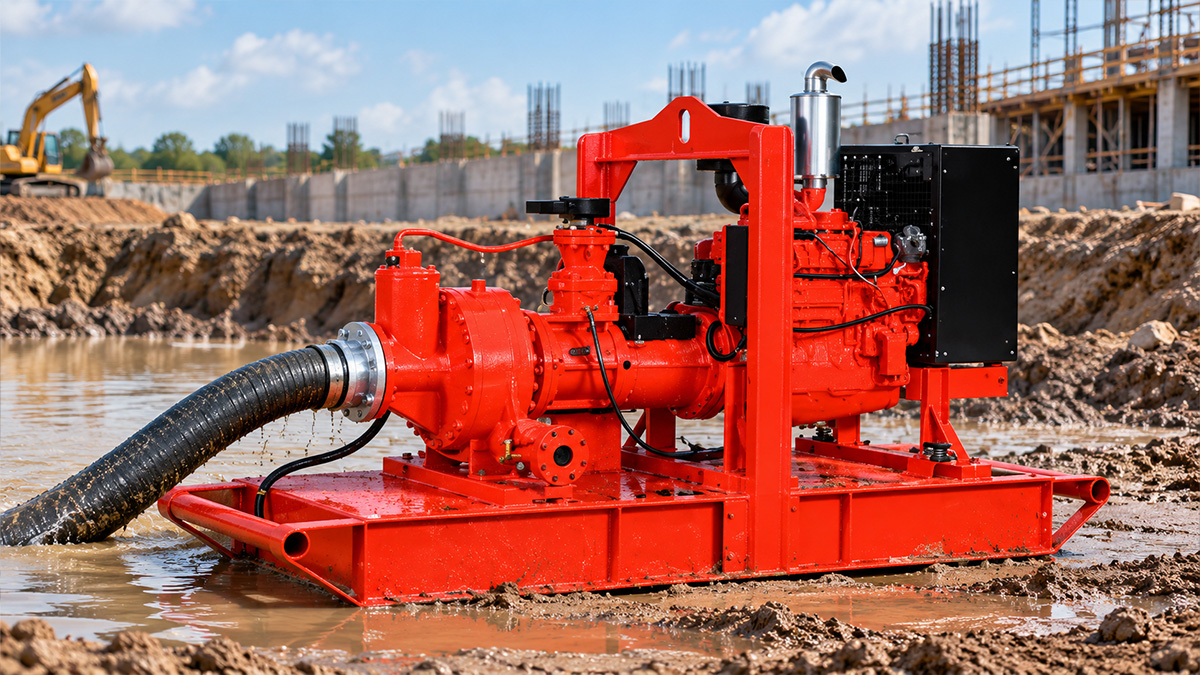
Trash and semi-trash pumps: The standard choice for open construction pits. They feature open impellers and heavy cast-iron casings that pass small stones, mud, and sand without jamming.
Slurry pumps: If you are running deep piling rigs or pulling up heavy bentonite drilling mud, you need a slurry pump with an agitator and hardened wear plates to churn through thick sludge.
Matching the pump housing and impeller to the water condition avoids blockages and burnt motors.
Select the Right Pump Type for Your Job
Construction jobs generally use one of two pump configurations:
- Surface-Mounted Diesel Centrifugal Pumps-These units sit on dry ground beside the cut, with a reinforced suction hose dropped into the sump.
- Electric Submersible Pumps-These units drop straight into the bottom of the sump and push water up through a discharge hose.
Account for Bahrain’s Soil and Climate Conditions
Bahrain’s soil and summer heat put unique wear on dewatering gear:
- Salty coastal water: Excavations hit brackish or saline groundwater. Brine corrodes mild steel quickly and ruins cheap rubber seals. Pumps with ductile iron casings, stainless shafts, and bronze fittings hold up much longer.
- Abrasive sand: Trench walls shed fine silica sand that acts like liquid sandpaper inside a pump. Always drop your suction hose inside a screened basket, and ensure the pump uses oil-bathed silicon carbide seals.
- Extreme summer heat: With midday temperatures hitting 45°C or higher, diesel engines running non-stop in the sun will boil over if radiators are clogged with dust. Keep air filters clean and engine oil topped up.
Buying vs. Renting Dewatering Equipment in Bahrain
Unless your firm digs deep foundations every month of the year, renting dewatering equipment usually makes better financial sense.
- Purchasing heavy pumps ties up capital in machinery that sits parked in your yard once backfilling is done.
- A villa boundary wall might only need a 3-inch trash pump for three days, while a commercial basement needs two 6-inch pumps for eight weeks. Renting lets you change sizes as the job shifts.
- A professional rental company services, oils, and tests the unit before delivery. You do not have to buy spare impellers or pay mechanics.
- If a pump acts up while water is rising, your rental partner can swap it out before the site floods.
Why Partner with AISCO for Dewatering Pumps in Bahrain
When water threatens to stall your earthworks, you need working machinery on site without delay.
AISCO (Arabian International Services Co. W.L.L.) provides heavy equipment hire and machinery rental across the Kingdom of Bahrain. When you need dependable dewatering pumps in Bahrain, AISCO supplies field-tested units backed by prompt local support.
What You Get with AISCO Dewatering Solutions:
- High-volume water clearance: Fuel-efficient diesel pumps that drain basements, trenches, and foundation pits quickly.
- Compact footprint: Sized to maneuver into crowded residential plots and tight city jobsites where space is limited.
- Maintained for low fuel burn: Regularly serviced diesel engines cut running costs and prevent mid-shift breakdowns.
- Complete site machinery: Need excavators, backhoes, bulldozers, cranes, or mobile generators? You can source the whole setup from one provider.
- Fast dispatch: Direct transport across Bahrain gets pumps onto your site when you need them.
Get in touch with AISCO to check pump availability or get a quote for your site
Frequently Asked Questions (FAQs)
What size pump do I need for a residential basement excavation in Bahrain?
Most residential basement digs in Bahrain need a 3-inch or 4-inch trash pump moving between 80 and 150 m³/hr. The exact choice depends on your distance to the coast and how quickly water seeps through the trench walls.
Can a regular water pump handle muddy water with sand and gravel?
No. Standard clean-water pumps will choke on debris and suffer ground-down impellers within days. Always use a trash pump or slurry pump designed with open impellers and wear-resistant cast iron to handle solids.
Why does saline water matter when choosing a pump in Bahrain?
Bahrain’s coastal groundwater has high salt levels that quickly rust carbon steel and degrade standard mechanical seals. Choosing pumps with ductile iron casings and silicon carbide seals prevents early leaks and motor failure.
